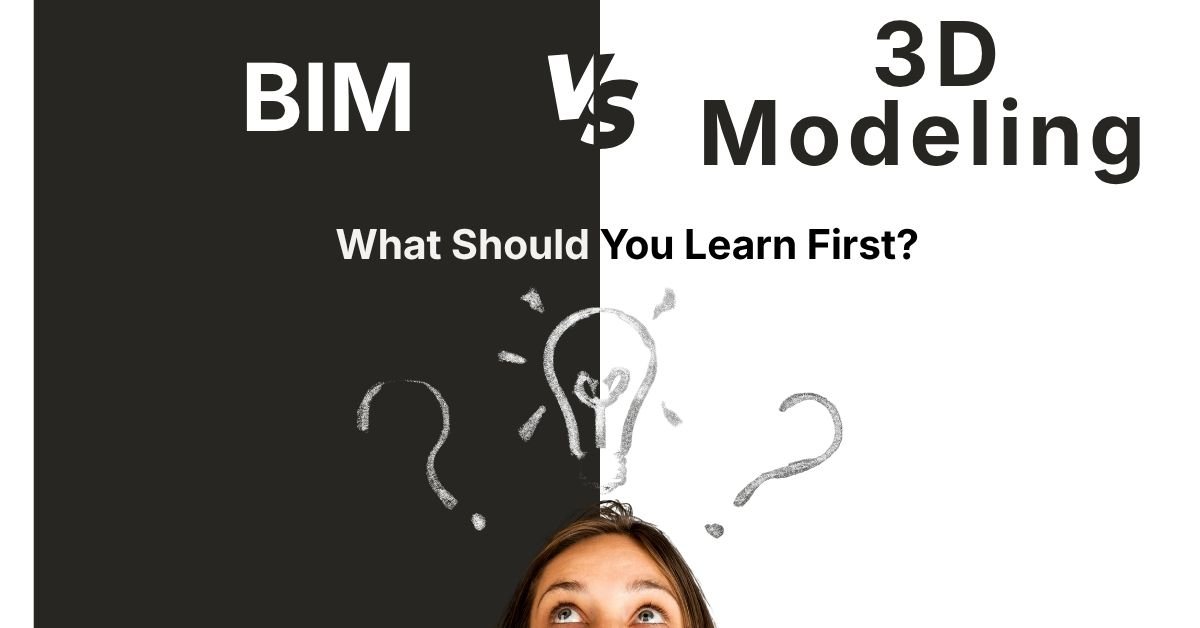
If you’re planning to enter the architecture, construction, or design industry, one common confusion is: Should I learn BIM or 3D modeling first?
This is not just a beginner question—it’s a career decision.
Understanding BIM vs 3D Modeling properly will help you choose the right learning path, save time, and avoid switching directions later.
In this blog, I’ll break everything down in a simple, practical, and no-confusion way—so you can decide what to learn first based on your goals.
What is BIM?
BIM (Building Information Modeling) is not just about design—it’s about complete building data.
It includes:
- 3D modeling
- Material information
- Cost estimation
- Construction planning
Popular BIM tools:
- Revit
- Navisworks
- Archicad
👉 BIM is widely used in real construction and infrastructure projects.
What is 3D Modeling?
3D modeling focuses mainly on visual design and creativity.
It includes:
- Creating 3D objects
- Rendering realistic images
- Animation and visualization
Popular tools:
- SketchUp
- Blender
- 3ds Max
👉 3D modeling is commonly used in interiors, animation, gaming, and visualization.
BIM vs 3D Modeling: Core Difference
Let’s make this super simple.
- BIM = Data + Construction + Accuracy
- 3D Modeling = Design + Visualization + Creativity
This is the most important concept in BIM vs 3D Modeling.
BIM vs 3D Modeling: Detailed Comparison
1. Purpose
BIM:
- Used for real construction projects
- Helps engineers, architects, and contractors
3D Modeling:
- Used for presentation and visuals
- Helps designers and artists
👉 In BIM vs 3D Modeling, BIM is more technical, while 3D modeling is more creative.
2. Career Opportunities
BIM:
- BIM Engineer
- BIM Coordinator
- BIM Manager
3D Modeling:
- 3D Artist
- Interior Visualizer
- Animator
👉 BIM generally has more stable job demand in the AEC industry.
3. Learning Curve
BIM:
- Slightly complex
- Requires understanding of construction
3D Modeling:
- Easier to start
- More intuitive for beginners
👉 In BIM vs 3D Modeling, 3D modeling is easier initially.
4. Salary Potential
BIM:
- Higher long-term growth
- Strong demand in infrastructure projects
3D Modeling:
- Depends on creativity and portfolio
- Competitive field
👉 BIM often offers better ROI over time.
5. Software Complexity
BIM Tools:
- Data-heavy
- Technical workflows
3D Tools:
- Design-focused
- Visual workflows
BIM vs 3D Modeling: What Should You Learn First?
Now the most important question.
Here’s the clear answer based on your goals:
If Your Goal is Construction or Engineering
Go with BIM first.
Why?
- Industry demand is high
- Direct job opportunities
- Better career stability
If Your Goal is Interior Design or Visualization
Start with 3D modeling first.
Why?
- Helps you build creative skills
- Easier to learn initially
- Great for portfolio building
If You Are Completely Confused
Start with:
👉 Basic 3D modeling → then move to BIM
This is the smartest approach in the BIM vs 3D Modeling journey.
Real-World Insight (Very Important)
Here’s what actually happens in the industry:
- Many BIM professionals know basic 3D modeling
- But many 3D artists don’t know BIM
👉 This means BIM has broader career scope.
So in the debate of BIM vs 3D Modeling, BIM often gives you more long-term opportunities.
Can You Learn Both?
Yes—and that’s the best strategy.
Ideal path:
- Start with basic 3D modeling
- Learn visualization concepts
- Move to BIM for technical skills
This combination makes you:
- More valuable
- More employable
- More versatile
Common Mistakes Students Make
Avoid these:
- Choosing 3D modeling just because it looks easy
- Ignoring BIM due to complexity
- Not understanding career goals
- Learning software without fundamentals
Understanding BIM vs 3D Modeling properly helps you avoid these mistakes.
Conclusion
So, in BIM vs 3D Modeling, what should you learn first?
Here’s the final answer:
- Choose BIM if you want a technical, stable career
- Choose 3D modeling if you want a creative path
- Learn both if you want maximum opportunities
Don’t just follow trends—choose based on your career goal.
Because the right start will decide your entire journey.
FAQ
Usually no. Free courses provide basic knowledge but lack practical training and certification needed for jobs.
Yes, if you are serious about your career. In Free vs Paid BIM Courses, paid courses offer better ROI.
Yes, but only basics. For advanced skills and job readiness, paid training is recommended.
Check:
- Course syllabus
- Trainer experience
- Placement support
- Student reviews